
You are trying to move USDC from an Ethereum wallet to an account on an EVM-compatible network. A swap interface quotes an attractive rate, but the transaction involves a bridge, a token approval, several contract calls, and a destination asset that may not be the same token in the way you expect. The practical question is not simply, “Which route is cheapest?” It is, “What exactly will happen to my assets, through which contracts, and what can go wrong before the funds arrive?”
Cross-chain swaps sit at the intersection of decentralized exchange liquidity, blockchain messaging, bridge design, and wallet security. A browser wallet such as Rabby can help users inspect transaction details and interact with applications across Ethereum and other EVM chains, but it does not remove the underlying risks. Understanding that boundary is essential. Wallet software is an interface and signing tool; it is not a guarantee that every bridge, token, quote, or decentralized application is safe.
What a cross-chain swap actually does
A conventional swap usually changes one asset for another on the same blockchain. An automated market maker, or AMM, uses liquidity pools and a pricing formula to determine how much of token B a trader receives for token A. A cross-chain swap adds a second problem: the source chain and destination chain maintain separate states. Ethereum cannot natively update an account balance on another network simply because a transaction succeeded on Ethereum.
That means a cross-chain route generally combines two functions. First, it exchanges or transfers value on the source network. Second, a bridge or cross-chain messaging system causes an equivalent representation, release, or delivery of value on the destination network. Some designs lock an asset in a contract and mint a representation elsewhere. Others use liquidity supplied on multiple chains, allowing a user to deposit on one network while a provider pays out on another. Atomic or intent-based systems may match a desired outcome without exposing the user to every intermediate step.
This distinction creates a useful mental model: a cross-chain swap is not one transaction in the ordinary sense. It is a coordinated sequence with multiple trust assumptions. A displayed “single-click” experience may conceal approvals, source-chain swaps, bridge messages, destination-chain swaps, and relayer activity. The interface can be simple while the underlying operation remains complex.
For US users, the difference matters when comparing a route by its advertised fee. A low quoted fee may be offset by network gas, price impact, an exchange-rate spread, a destination-chain fee, or a bridge liquidity charge. More importantly, a cheap route may rely on a less familiar bridge or a thin destination pool. The best route is therefore not always the one showing the highest token amount at the first screen. It is the route whose total cost and operational risk fit the value and urgency of the transfer.
Three approaches, three different risk profiles
Native or canonical bridging
A canonical bridge is designed around a particular asset and a defined relationship between two networks. Its architecture may offer a clearer path for moving an asset than an improvised combination of contracts. The trade-off is often speed, liquidity, and network coverage. A transfer can take longer if it depends on message finality or a verification process, and the received asset may still need a separate swap before it is useful.
Canonical does not mean risk-free. Bridge contracts can contain bugs, validator or relayer arrangements can introduce trust assumptions, and users can still send funds to the wrong network or unsupported token contract. “Official” should be treated as a design description, not as a substitute for checking the actual destination, token, and transaction state.
Liquidity-based cross-chain aggregators
Liquidity-based systems attempt to provide faster delivery by maintaining pools or professional liquidity on several chains. A user may receive funds on the destination network before a deeper settlement process is visible to them. This can be convenient, particularly when moving familiar assets between active EVM ecosystems.
The principal trade-off is that the user is relying on both smart contracts and the liquidity provider or routing system. If destination liquidity is shallow, the effective price can deteriorate quickly. If a route uses an unfamiliar wrapped asset, the token may trade at a discount or have limited exit liquidity. A swap can technically complete while still producing an economically poor result.
Intent-based or solver-mediated routes
Intent-based systems allow a user to specify an outcome, such as receiving a certain amount of an asset on a destination chain, while a solver or network of providers determines how to execute it. This can reduce the number of decisions presented to a non-specialist and may improve execution across fragmented liquidity.
Yet abstraction moves complexity rather than eliminating it. The user must understand who fills the intent, how failure is handled, what happens if the quoted outcome becomes unavailable, and whether the application has permission to spend more than intended. These systems may be efficient, but their safety depends on contract design, quote validity, solver incentives, and the quality of the application interface.
Where a browser wallet helps—and where it cannot
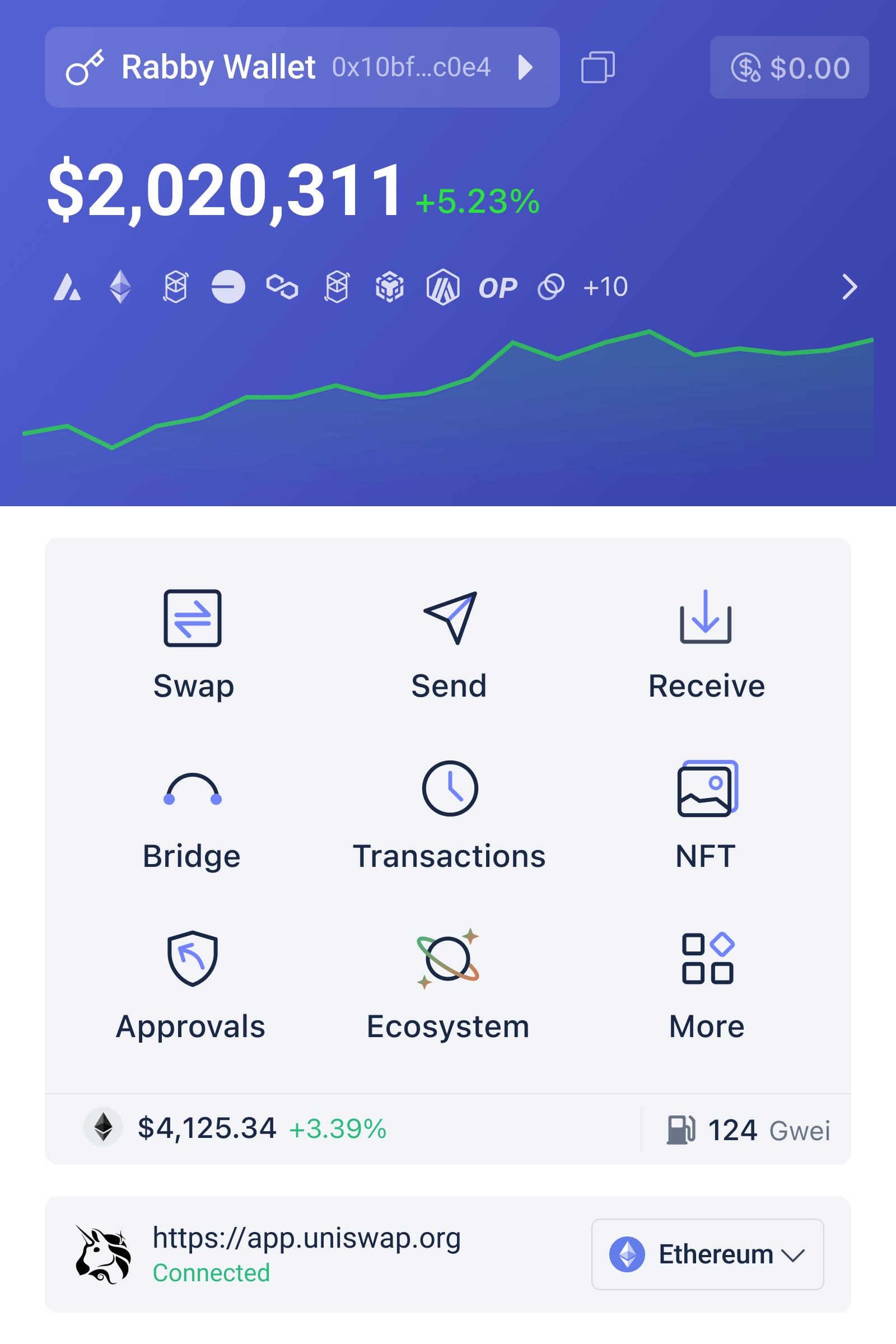
Rabby is positioned for Ethereum and EVM activity, and the project’s recent messaging emphasizes a browser extension for Chrome and Brave across EVM chains. For a DeFi user, the practical value of an extension is not merely that it stores an address. It provides a controlled point at which a user connects to an application, selects a network, reviews a transaction, and signs it.
If you are preparing to install the extension, use the official project route and verify the browser’s extension publisher before creating or importing a wallet. The rabby wallet download resource can serve as a starting point, but users should still apply normal verification discipline: check the domain, avoid sponsored search results that imitate wallet pages, and never enter a recovery phrase into a website, support form, or pop-up.
A wallet can improve transaction awareness by showing the network, recipient, contract interaction, token approvals, and estimated changes to balances. That is valuable because many wallet attacks are not cryptographic failures; they are authorization failures. A user signs a transaction that grants unlimited spending permission, transfers an asset to an unintended address, or interacts with a malicious contract while believing the action is only a routine swap.
However, a simulation or warning is an aid to judgment, not proof of safety. Contract behavior can depend on external calls, market conditions, block timing, and permissions already granted. A clean-looking preview cannot guarantee that a bridge will remain solvent, that a token is genuine, or that a destination chain will process a message as expected. The user still has to verify the application and understand the action being authorized.
A security framework for evaluating a route
Before signing, separate the route into four questions: identity, authorization, economics, and recovery. Identity asks whether the application, bridge, token contract, and destination network are the intended ones. This is especially important with similarly named tokens and cloned websites. A token symbol is not a unique identifier; the contract address and network matter.
Authorization asks what permission the transaction grants. An approval may allow a contract to spend a particular token, sometimes without a narrow limit. If the application does not require a large allowance, a smaller amount is generally easier to contain. After completing a high-value operation, users should review and revoke unnecessary approvals using a trusted tool or the wallet’s available controls. Revocation itself costs gas and is not a universal cure, but reducing stale permissions limits future exposure.
Economics asks what the user receives after every fee and conversion. Compare the minimum received amount, price impact, slippage tolerance, source and destination gas, bridge fee, and the identity of the destination asset. A route that delivers a wrapped version of an asset is not equivalent to a route delivering the native or canonical version if the two have different liquidity and redemption mechanisms.
Recovery asks what happens when the process is interrupted. The source transaction may succeed while the destination delivery is delayed. A user may need a transaction hash, a message identifier, or a support process to trace the state. Before moving a large balance, test a small amount and confirm that the destination token can be used or exchanged. A small test is not proof that every future transaction will work, but it exposes network, address, and token-compatibility mistakes at limited cost.
One non-obvious risk is the mismatch between transaction success and user success. A source-chain transaction can be finalized even when the overall cross-chain objective has not been achieved. In other words, “confirmed” may describe only one leg of the operation. This is why users should track the complete route rather than closing the browser immediately after the first confirmation.
Best-fit choices for different users
For a small, routine transfer of a widely used asset, a well-established route with adequate liquidity may be preferable even if it is not the absolute cheapest. Operational simplicity has value when it reduces the chance of selecting the wrong chain or approving the wrong contract. For a large transfer, security review and a test transaction should outweigh minor savings in fees.
For a time-sensitive trade, a liquidity-based or solver-mediated route may offer faster delivery, but the user should examine the provider’s failure behavior and the destination asset carefully. For a long-term holder, minimizing bridge exposure may be more important than immediate speed. The appropriate comparison is therefore not “bridge versus swap” in the abstract. It is a fit between asset, amount, urgency, chain pair, liquidity, and tolerance for third-party or contract risk.
Rabby’s role becomes most useful when treated as part of an operational process rather than as a security guarantee. Keep the extension browser profile separate from casual browsing when practical, protect the recovery phrase offline, consider a hardware wallet for material holdings, and verify the active network before signing. A hardware wallet can protect private-key use, but it cannot make a malicious transaction economically harmless if the user approves it on the device.
What to watch next
The direction of cross-chain infrastructure will likely be shaped by whether users can obtain reliable outcomes without having to understand every underlying message or liquidity movement. Better simulation, clearer destination-asset labeling, and more transparent failure states could reduce avoidable mistakes. At the same time, greater abstraction may make it easier to approve an action whose complexity is hidden from the user.
The signal to watch is not simply faster settlement. It is whether speed is accompanied by verifiable guarantees, understandable permissions, resilient liquidity, and clear recovery procedures. If those elements improve together, cross-chain swaps may become safer for ordinary DeFi activity. If interfaces advance faster than the underlying controls, convenience could instead widen the gap between what a user thinks they authorized and what the contracts actually did.
Frequently asked questions
Is a cross-chain swap the same as a bridge transfer?
No. A bridge transfer moves or represents value between networks, while a cross-chain swap may also exchange one token for another. Many user-facing routes combine both functions, which is why the final amount, token type, fees, and security assumptions must be checked separately.
Does installing Rabby make cross-chain swaps safe?
No wallet can guarantee that a decentralized application or bridge is safe. Rabby can help present transaction and approval information, but users must still verify the application, network, token contract, permissions, quoted output, and destination status. For substantial amounts, a small test and hardware-wallet signing are prudent controls.
What is the safest first step before using a new route?
Confirm the official application address through an independent trusted source, inspect the network and destination token, review the allowance and minimum received amount, and send a small test transaction. Keep the recovery phrase offline and never disclose it to a website or person claiming to provide wallet support.